
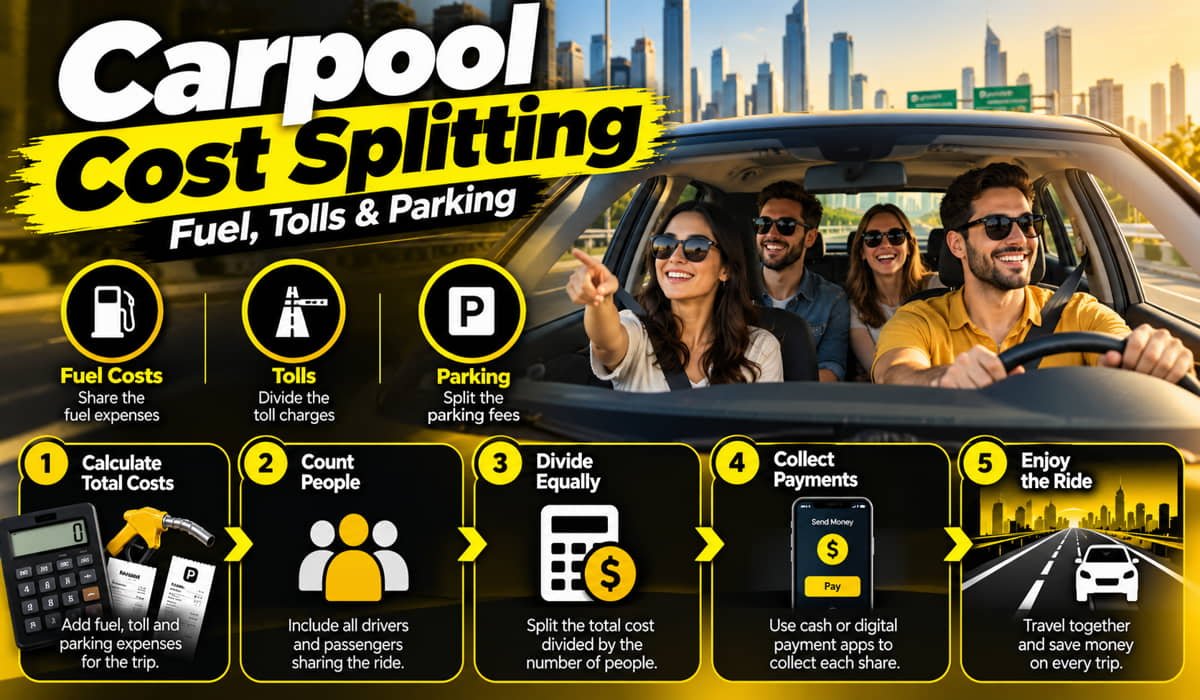
Carpool cost splitting means dividing the expenses of a shared car journey among the people who agree to contribute. These expenses usually include fuel, road tolls, parking fees, and other trip-related costs agreed upon before travelling. The fairest method depends on who is travelling, how far each person goes, and whether the driver also contributes.
For a straightforward journey, you can add the shared expenses and divide the total equally. If passengers join or leave at different points, calculating costs by journey segment may be more appropriate.
Agreeing on the rules before departure helps everyone understand what they owe and prevents payment disputes afterward.
What Is Carpool Cost Splitting?
Carpool cost splitting is the process of calculating shared driving expenses and deciding how much each contributor should pay. Friends travelling together, colleagues commuting to work, and passengers sharing a regular journey can all use this method.
The goal is to agree on a reasonable contribution toward the journey’s actual cost. For example, if four people agree to share AED 60 in fuel, tolls, and parking expenses equally, each person contributes AED 15.
However, equal sharing is not always the right approach. One passenger might travel only part of the route, another might request an additional stop, or the driver might agree to cover a larger portion of the expenses.
The group should choose a method that reflects its arrangements rather than assuming every journey must be divided in the same way.
Which Expenses Should Be Included in a Carpool?
The main expenses to consider are:
- Fuel: The estimated or actual fuel used for the shared journey.
- Road tolls: Charges incurred while travelling along the agreed route.
- Parking: Parking fees that benefit the group or form part of the shared trip.
- Other agreed expenses: Additional journey-related costs that everyone has agreed to share.
Record each expense separately before calculating the total. This makes it easier to explain the final amount and correct any mistakes.
For example, if the group shares fuel and tolls but agrees that one passenger will pay for parking at a personal appointment, that parking fee should not automatically be included in the shared total.
Which Expenses Should Be Agreed on Before the Trip?
Some costs require a discussion because people may have different expectations about who should pay.
Examples include vehicle wear, maintenance, depreciation, detours, waiting time, and additional stops. The driver may wish to include some vehicle-related costs in the agreed contribution, while passengers may expect to share only the direct expenses of the journey.
Neither approach should be assumed without discussion. For an ordinary shared journey, the group can agree to split fuel, tolls, and parking only. For a recurring arrangement, it may also agree on a reasonable contribution toward other costs.
Settle these questions before travelling, especially when the journey involves several passengers or regular commuting.
How to Calculate the Total Cost of a Carpool Trip
Start by listing every expense that the group has agreed to share. Calculate the fuel cost, add the applicable tolls and parking charges, and include any other agreed expenses.
Formula:
Total Shared Expenses = Fuel Cost + Tolls + Parking + Other Agreed Costs
For example, suppose a journey has these expenses:
| Expense | Amount |
| Fuel | AED 30 |
| Road tolls | AED 10 |
| Parking | AED 20 |
| Total | AED 60 |
The calculation is AED 30 + AED 10 + AED 20 = AED 60.
These figures are hypothetical and demonstrate the calculation only. Actual expenses depend on the vehicle, route, fuel price, and applicable charges.
If the group incurs additional tolls or parking fees during the journey, update the total using the actual amounts. Avoid estimating the final contribution from fuel alone when other shared expenses are involved.
Decide How Many People Will Share the Cost
The contributor count affects the amount each person pays. Before calculating individual shares, agree whether the driver contributes and whether all occupants or only the passengers will divide the expenses.
For example:
- Four contributors, including the driver, share the total.
- Three passengers share the total while the driver covers no portion.
- The driver contributes a larger share while passengers divide the remainder.
Each arrangement produces a different result. The key is to use the same agreed contributor count throughout the calculation.
Calculate the Cost per Person
For equal sharing, divide the total shared expenses by the number of contributors.
Formula:
Cost per Person = Total Shared Expenses ÷ Number of Contributors
Using the AED 60 example, if four people contribute equally:
AED 60 ÷ 4 = AED 15 per person
Each person pays AED 15.
If only three passengers share the expenses and the driver does not contribute:
AED 60 ÷ 3 = AED 20 per passenger
This method works when the group has agreed to share the listed expenses equally. For passengers travelling different distances, an allocation based on journey segments may be more suitable.
How to Split Fuel Costs Fairly
Fuel is often the largest variable expense in a shared journey. The amount depends on the distance travelled, the vehicle’s fuel consumption, and the price paid per litre.
You can estimate fuel expenses before departure using the vehicle’s average consumption. If the journey has already taken place, you can use a reasonable estimate or actual trip-related fuel records, provided the method is agreed upon.
Calculate Fuel Consumption From Distance
For a vehicle whose fuel consumption is measured in litres per 100 kilometres, multiply the journey distance by the vehicle’s average fuel consumption, then divide the result by 100.
Formula:
Fuel Used (Litres) = Distance (km) × Fuel Consumption (L/100 km) ÷ 100
For example, suppose a car travels 150 km and averages 8 litres per 100 km.
150 × 8 ÷ 100 = 12 litres of fuel
The estimated fuel consumption for the journey is 12 litres.
This is an estimate rather than a guarantee. Traffic, air conditioning, road conditions, driving style, and vehicle load can affect actual fuel consumption.
If the vehicle’s fuel economy is expressed in kilometres per litre instead, divide the distance by that figure to estimate the fuel used.
Calculate the Total Fuel Cost
Once you know the estimated fuel consumption, multiply it by the fuel price per litre.
Formula:
Fuel Cost = Fuel Used (Litres) × Price per Litre
Suppose the car uses an estimated 12 litres and fuel costs AED 3 per litre for this illustration.
12 × AED 3 = AED 36
The estimated fuel cost is AED 36.
If four contributors agree to divide this fuel expense equally, each contributes AED 9 toward fuel. Any shared tolls and parking fees must be added separately before calculating the final trip contribution.
Use the actual applicable fuel price and a reasonable estimate of journey consumption. Do not treat the illustrative price above as a current fuel rate.
Should the Driver Pay an Equal Share?
The driver does not automatically have to pay an equal share under every carpool arrangement. The group should agree on the driver’s contribution before the journey.
There are three common approaches:
- Equal contribution: The driver and passengers divide all agreed expenses equally.
- Passenger-only contribution: The passengers share the expenses while the driver contributes no cash.
- Unequal contribution: The driver covers part of the total, and passengers divide the remainder.
The first approach is straightforward when everyone benefits similarly from the journey. Passenger-only sharing may suit a particular arrangement in which the driver provides the vehicle and driving effort. An unequal split may be suitable when the group agrees that different contributions are fairer.
For example, if shared expenses total AED 60 and the driver agrees to cover AED 20, the remaining AED 40 can be divided equally among three passengers.
AED 40 ÷ 3 = approximately AED 13.33 per passenger.
A small rounding adjustment may be needed to settle the exact total. The driver pays AED 20, and the passengers collectively cover the remaining AED 40. This arrangement works if everyone has agreed to it, but it is not the same as an equal four-person split.
How to Divide Tolls and Parking Fees
Tolls and parking fees are generally easier to calculate than fuel because they can often be recorded as actual charges. The main decision is determining which people should share each expense.
For a simple journey in which everyone travels the same route, the group can divide the applicable charges equally. When passengers travel different distances or benefit from different stops, allocating costs by segment or use may be fairer.
How to Split Road Toll Charges
Add the toll charges incurred during the agreed journey, then apply the group’s chosen sharing method.
Suppose the car passes through two toll points, with charges of AED 5 and AED 7.
AED 5 + AED 7 = AED 12 in total tolls.
If four contributors agree to share these tolls equally:
AED 12 ÷ 4 = AED 3 per contributor.
If a passenger joins the car after one toll point, the group can decide whether that passenger should contribute only toward tolls incurred after joining. This is especially useful when the journey has several pickup points.
Record the actual charges where possible. Do not assume every passenger must pay the same toll contribution if the agreed journey segments differ.
How to Share Parking Costs
Parking should be allocated according to the group’s agreement and the purpose of the stop.
If four people travel together and the car incurs AED 20 in parking fees for an activity everyone attends, an equal split would be:
AED 20 ÷ 4 = AED 5 per contributor.
However, suppose the group drops one passenger at a personal appointment and the driver parks only for that person’s activity. The group might agree that the passenger covers the parking fee instead of sharing it among everyone.
The important distinction is between parking that supports the shared journey and parking incurred for an individual activity. Clarifying this before the stop avoids confusion later.
How to Handle Multiple Stops
Additional stops can change the journey’s total distance, toll charges, parking costs, and travel time. A quick pickup along the planned route may have little effect, while a substantial detour may create a noticeable additional expense.
Record the extra distance and any new charges. Then apply the method agreed upon by the group.
For example, if one passenger requests a separate destination that adds fuel and parking expenses, the group can agree that the requesting passenger covers those additional costs. Alternatively, everyone can share them if the stop benefits the group.
Avoid automatically spreading every extra expense across all contributors. The allocation should reflect the reason for the stop and the arrangement accepted by the people involved.
Carpool Cost-Splitting Examples
The following examples demonstrate different ways to calculate shared driving expenses. All amounts are hypothetical and are intended to explain the arithmetic, not to represent typical or current prices.
Example of Splitting a One-Way Journey
Suppose four people, including the driver, agree to share a one-way trip with these expenses:
| Expense | Amount |
| Fuel | AED 30 |
| Tolls | AED 10 |
| Parking | AED 20 |
| Total trip cost | AED 60 |
Step 1: Calculate the total.
AED 30 + AED 10 + AED 20 = AED 60.
Step 2: Count the contributors.
The driver and three passengers contribute, making four contributors.
Step 3: Divide the total equally.
AED 60 ÷ 4 = AED 15 per contributor.
Each person pays AED 15. The four contributions add up to AED 60, covering the agreed expenses.
Example of Splitting Round-Trip Expenses
A round trip may include separate fuel, toll, and parking costs for the outward and return journeys.
Suppose the expenses are:
| Expense | Outward journey | Return journey |
| Fuel | AED 30 | AED 35 |
| Tolls | AED 10 | AED 10 |
| Parking | AED 20 | AED 0 |
| Total | AED 60 | AED 45 |
The total round-trip expense is AED 60 + AED 45 = AED 105.
If three people, including the driver, agree to share the full amount equally:
AED 105 ÷ 3 = AED 35 per contributor.
Each contributor pays AED 35.
This example includes parking only on the outward journey. If additional parking fees or other agreed charges arise on the return trip, add them before calculating each share.
Example With Three or Four Contributors
The same total expense produces different individual contributions depending on the number of people sharing it.
Assume the total cost is AED 60.
| Number of contributors | Calculation | Contribution per person |
| 2 | AED 60 ÷ 2 | AED 30 |
| 3 | AED 60 ÷ 3 | AED 20 |
| 4 | AED 60 ÷ 4 | AED 15 |
As the contributor count increases, the equal contribution per person decreases.
This comparison assumes that all listed expenses are shared equally and that each person is counted as a contributor. If one person pays a larger share or some expenses apply only to certain passengers, calculate those amounts separately.
Example: When the Driver Does Not Contribute Equally
Suppose a carpooling trip from Dubai to Abu Dhabi costs AED 60, and the driver agrees to pay AED 20. Three passengers will divide the remaining amount equally.
First, subtract the driver’s contribution:
AED 60 − AED 20 = AED 40 remaining.
Then divide the remaining expense among the three passengers:
AED 40 ÷ 3 = approximately AED 13.33 per passenger.
Each passenger contributes approximately AED 13.33, with a small adjustment to ensure the final payments add up to exactly AED 40.
The driver pays AED 20, and the passengers collectively cover the remaining AED 40. This is a fair arrangement if everyone has agreed to it, but it is not the same as an equal four-person split.
How to Split Carpool Costs When Everyone Travels Different Distances
Equal sharing can be unfair when passengers join or leave the car at different points. Someone travelling for 10 km may not reasonably be expected to contribute the same amount as someone travelling for 100 km if the group intends to allocate costs according to distance.
A segment-based approach can make the calculation clearer. Divide the journey into sections based on pickup and drop-off points, calculate the expenses for each section where practical, and allocate those costs to the people travelling on it.
Calculate Costs by Journey Segment
Start by listing the main points where passengers enter or leave the car.
For example, suppose the journey has three segments:
- Segment A to B: the driver and two passengers travel together.
- Segment B to C: the driver and one passenger continue.
- Segment C to D: only the driver remains.
If the group chooses distance-based sharing, the costs of each segment can be allocated among the people travelling during that section. The driver can be counted as a contributor or treated differently, depending on the agreed arrangement.
Fuel consumption can be estimated for each segment using its distance and the vehicle’s average fuel economy. Tolls should be assigned according to the group’s agreement and the relevant route. Parking fees should be allocated according to who benefits from the stop.
Not every expense can be divided perfectly by distance. A toll may apply to a particular route, while parking may be associated with one destination. Use the actual expense and a transparent rule rather than forcing every cost into a single formula.
Handle Detours and Additional Stops
A detour changes the original journey plan. The group should decide whether the additional expense belongs to the person requesting the detour or should be shared by everyone.
For instance, if one passenger asks the driver to travel an extra 15 km to reach a separate destination, the group can estimate the additional fuel cost and assign it to that passenger. Any additional toll or parking fee can be handled in the same way.
If everyone benefits from the detour, sharing the cost may make more sense.
Agreeing on this rule in advance is particularly useful for recurring carpools, where frequent additional stops can gradually increase the total expense.
Before a carpool ride, you must know about the general etiquettes of carpooling.
Deal With Cancellations and No-Shows
Cancellations can affect cost sharing when the driver has already made arrangements, taken a detour, or incurred a charge that cannot be recovered.
The group should decide in advance how cancellations will be handled. For example, members may agree that anyone cancelling before a stated deadline has no obligation for avoidable expenses, while costs already incurred under a prior agreement may be handled separately.
Do not assume there is one universal cancellation rule for all carpools. The appropriate arrangement depends on the group’s agreement, the timing of the cancellation, and the expenses already incurred.
For regular commuting, a simple written policy can prevent repeated disagreements about last-minute changes.
How to Track and Settle Shared Carpool Expenses
A clear record makes cost sharing easier, especially when a journey includes several passengers, multiple stops, or a return trip.
The process can be simple: record the expenses, calculate the agreed shares, collect contributions, and confirm that the total has been settled.
Keep Receipts and Record Actual Costs
Record fuel, tolls, and parking separately. Include the date, amount, and purpose of each expense where relevant.
For fuel, note the amount used in the calculation and whether it is an estimate or an actual trip-related figure. For tolls and parking, use receipts or available transaction records when possible.
Keep the final calculation visible to everyone contributing. If an expense changes after the journey, update the record and explain the adjustment.
Use a Spreadsheet or Expense-Splitting App
A shared spreadsheet can record each expense and calculate each person’s contribution. A basic layout might include:
| Date | Expense | Amount | Contributors | Notes |
| Trip date | Fuel | AED 30 | 4 | Estimated trip fuel |
| Trip date | Tolls | AED 10 | 4 | Actual charges |
| Trip date | Parking | AED 20 | 4 | Shared destination |
| Total | AED 60 |
A spreadsheet can also include each person’s calculated share and payment status. For journeys with different pickup points, add columns for journey segments or identify which people are responsible for each expense.
Expense-splitting apps can provide similar records and help track balances. Choose a tool that supports your group’s needs, and make sure everyone can understand the final calculation. The tool does not replace the need to agree on the allocation method.
Agree on Payment Timing and Method
Decide whether contributions will be collected before the trip, immediately afterward, or once all expenses are known.
For journeys with estimated fuel costs, you may need to reconcile the estimate against the agreed final amount. For tolls and parking, update the record when the actual charges are available.
Use a payment method everyone can access and keep a simple record of payments received. If rounding creates a small difference, agree on how to settle it so that the contributions cover the final total.
A short message listing the expenses, the method used, and the amount each person owes is often enough for a straightforward journey.
Common Carpool Cost-Splitting Mistakes to Avoid
Small misunderstandings can make an otherwise simple journey difficult to settle. Avoid these common mistakes:
- Forgetting tolls or parking: Calculate all agreed expenses, not just fuel.
- Using unrealistic fuel consumption: Base estimates on the vehicle’s reasonable average and the distance travelled.
- Counting contributors inconsistently: Decide whether the driver pays a share and use the same rule throughout the calculation.
- Ignoring different journey distances: Use segment-based allocation when passengers travel substantially different portions of the route.
- Sharing personal detours automatically: Agree on who covers extra expenses caused by an individual request.
- Mixing estimates with actual charges: Label estimated fuel costs clearly and update the calculation when necessary.
- Leaving cancellations unresolved: Set expectations for no-shows and late changes before the trip.
- Failing to explain the final amount: Show the expenses, total, contributor count, and calculation so everyone can check the result.
The best way to prevent disputes is to agree on the rules before departure and keep the arithmetic transparent.
Here are some of the tips before booking ride sharing services.
Final Thoughts
Carpool cost splitting works best when everyone agrees on the expenses and allocation method before travelling. Calculate fuel using distance, fuel economy, and price per litre, then add the actual tolls, parking fees, and any other costs the group has agreed to share.
For a straightforward journey, divide the total by the number of contributors. For journeys with different pickup points, detours, or individual stops, allocate expenses according to the relevant segments and agreed responsibilities.
Keep a record of the calculations and payments, and communicate any changes clearly. A transparent method helps drivers and passengers share expenses fairly without turning a convenient shared journey into a payment dispute.
