Author name: Pick and Drop Lift

car lift booking guide
Guides

What Information Is Needed to Book a Car Lift?

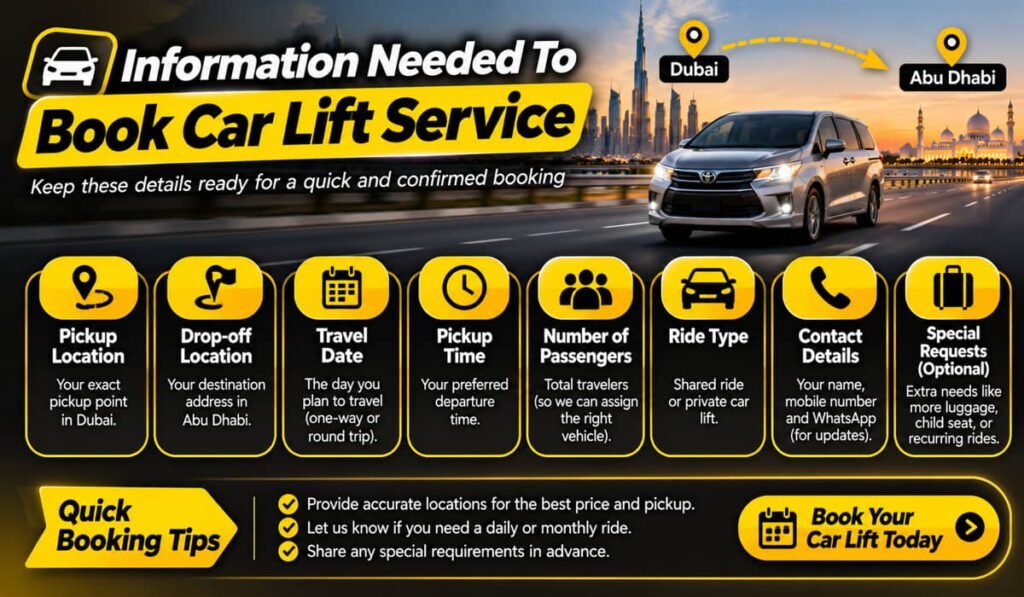
Booking a car lift is easier when you have your travel details ready before contacting a transportation provider. You generally need to share your pickup location, drop-off address, travel date, preferred time, number of passengers, and contact information. Depending on the journey, the provider may also ask whether you need a shared or private car lift, a one-way or round-trip journey, and whether you have luggage or special travel requirements. Providing accurate information helps the provider check availability, calculate the fare, arrange a suitable vehicle, and confirm your booking without unnecessary delays. What Information Do You Need to Book a Car Lift? Most car lift bookings require a few basic details about your journey and the passengers travelling. These details help the transportation provider understand where you need to be picked up, where you are going, and when you want to travel. Before contacting a provider, prepare: You may need to provide additional details for private rides, group bookings, or regular daily transportation. Essential Details Required for a Car Lift Booking Pickup Location Your pickup location tells the driver where to pick you up. Provide as much detail as possible so the driver can identify the correct meeting point. You can share: For example, instead of saying you need a pickup from Dubai Marina, mention your building name or a nearby meeting point. If you are travelling from Dubai to Abu Dhabi, your pickup location helps the provider determine the route, estimated journey time, and suitable meeting arrangements. Drop-Off Location The drop-off location tells the provider where you want to finish your journey. Share your destination address, building name, business location, or nearby landmark. If you need to reach a particular office, hotel, residential building, or shopping centre, mention it when requesting the booking. A specific destination is more helpful than providing only a city name. For example, if you are travelling to Abu Dhabi, clarify whether you need to reach the city centre, a particular residential community, an office, or another destination. Accurate pickup and drop-off details help the provider check route availability and give you a more relevant fare estimate. Travel Date and Preferred Time The provider needs to know when you want to travel so they can check vehicle and seat availability. Mention: For example, you might need a car lift from Dubai to Abu Dhabi on Monday at 7:00 AM because you have to reach your office before 9:00 AM. If your schedule is flexible, share an approximate departure window instead of giving an exact time. The provider can then tell you which available pickup times are suitable. Number of Passengers Always mention how many people will travel. This information helps the provider determine whether enough seats are available and whether a suitable vehicle is required. For example: If children are travelling, mention their ages when relevant, especially if you need child seats or other arrangements. Never assume that additional passengers can join after confirmation. The provider needs the correct passenger count before arranging the vehicle. Contact Information Your contact details allow the transportation provider or driver to communicate with you about the booking. Usually, you should share: The provider may use your number to confirm the pickup time, share meeting-point information, communicate delays, or coordinate with you on the travel day. Make sure your phone is reachable around the scheduled pickup time. Additional Information That May Be Required Some details are not essential for every booking but can help the provider arrange the right transportation. Shared or Private Car Lift Preference Tell the provider whether you prefer a shared or private car lift service. With a shared car lift, you book an available seat and travel with other passengers going in the same or a similar direction. This option is generally suitable for people who want to share transportation costs. Check our carpool cost splitting guide to know how to calculate your shared ride expense. With a private car lift, the vehicle is reserved for you or your group. It offers more control over the journey and pickup arrangements, subject to the agreed service conditions. Your choice can affect the fare, vehicle arrangement, and availability. If you are unsure which option suits your journey, explain your requirements and ask the provider about available arrangements. You can also compare the differences between a shared and private car lift before making a decision. One-Way or Round-Trip Booking Let the provider know whether you need transportation in one direction or both directions. A one-way booking covers a single journey from your pickup location to your destination. A round-trip booking involves travelling to your destination and arranging transportation back to your starting point or another agreed location. For a round trip, mention: If you are booking a return journey for another day, provide both travel dates so the provider can check availability for each trip. Luggage Requirements Mention your luggage requirements before confirming the booking, particularly when travelling with large bags or several suitcases. This is important because shared vehicles have limited storage space. Large luggage may affect how many passengers or bags the vehicle can accommodate. You should tell the provider: For example, one passenger travelling with a small backpack has different storage requirements from someone travelling with two large suitcases. Confirming this information in advance helps avoid problems at pickup. Special Travel Requirements Some passengers may need additional arrangements. Mention any relevant requirements when making your booking, such as: These requests depend on the provider’s vehicle, equipment, and availability. Always confirm that the arrangement is possible before finalizing the booking. What Information Is Needed for Daily or Monthly Car Lift Booking? Daily and monthly car lift arrangements require more information than a one-time journey because the provider needs to understand your regular travel schedule. If you commute between Dubai and Abu Dhabi for work, for example, you may need transportation on specific weekdays with fixed morning and evening timings. Prepare the following details: Required information What to provide Regular pickup location Your home, building, or meeting

best travel time from dubai to abu dhabi
Guides

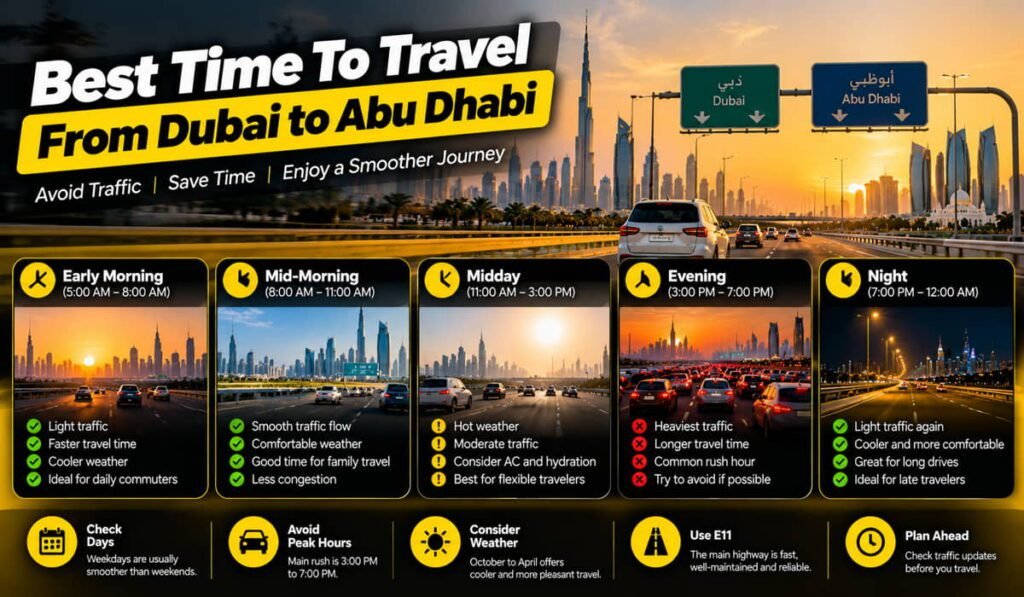
Best Time to Travel from Dubai to Abu Dhabi

The best time to travel from Dubai to Abu Dhabi depends on your starting location, destination, day of the week, and reason for travelling.  Leaving before busy commuting periods can help you avoid congestion, while travelling at midday or during other quieter times may offer a more predictable journey. However, traffic can change because of road incidents, construction, weather, and special events.  Whether you are driving your own car, taking a taxi, or booking a shared car lift, choosing a suitable departure time can noticeably improve your travel experience. Planning also helps you arrive on time for work, appointments, family visits, and sightseeing. What Is the Best Time to Travel from Dubai to Abu Dhabi? For many travellers, an early morning departure or a journey outside the main commuting periods can be a practical choice. Leaving before traffic builds up may help you make better progress on the road, particularly when your starting point is in a busy part of Dubai. There is no single departure time that is always best. Someone travelling from Dubai Marina to Yas Island may have a different journey from someone leaving Deira for Abu Dhabi Corniche. Current road conditions and the destination within each city also influence the decision. Consider these general departure options: Check live traffic before deciding when to leave. Typical traffic patterns are useful for planning, but they cannot predict every delay. Best Time to Leave Dubai in the Morning An early morning departure can be a good option for people who want to reach Abu Dhabi before the day becomes busy. It may also suit office commuters, business travellers, and visitors with morning appointments. The main consideration is the direction and location of traffic. Dubai’s roads experience commuter movement as people travel to work and school. The time required to leave a particular neighbourhood and reach a major highway can therefore affect the overall journey. If you have an early meeting in Abu Dhabi, plan your departure around your required arrival time rather than relying on the estimated highway journey alone. Include time for reaching the main road, possible congestion, and finding your destination after entering Abu Dhabi. Early travel can also involve reduced visibility during foggy weather, particularly in cooler months. Check official weather alerts and road conditions before setting off. Best Time to Travel During the Afternoon Midday and early afternoon can be practical departure periods for travellers with flexible schedules. They may avoid some of the morning office commute and allow you to reach Abu Dhabi before evening activities or appointments. However, afternoon conditions are not always quiet. School-related traffic, local shopping activity, roadworks, and traffic around commercial areas can affect different parts of the route. The timing of your arrival also matters. If you leave Dubai in the afternoon but need to reach a busy business district near the end of the working day, you may encounter congestion closer to your destination. Check the route from your exact pickup point to your final destination. A journey that looks clear on the highway may still involve delays on the approach roads. Best Time to Travel in the Evening Evening travel can be suitable for people visiting Abu Dhabi after work or attending an event, but it requires careful planning. Commuters leaving offices, local traffic, and visitors heading towards shopping or entertainment areas can influence road conditions. The direction of travel also matters. Traffic moving out of Dubai may behave differently from traffic entering the city, and the conditions around your destination can be just as important as those on the intercity highway. If you have a fixed arrival time, avoid planning your departure too close to the appointment. Check live traffic and allow additional time if the route shows congestion. Dubai to Abu Dhabi Traffic Patterns Throughout the Day Traffic between Dubai and Abu Dhabi changes throughout the day because of commuting, business travel, leisure trips, and local road activity. It is useful to understand general traffic patterns, but remember that they are not fixed schedules. An accident, road closure, event, or weather warning can change the journey even during a normally quieter period. Early Morning Traffic Early morning travel can be useful for people who want to reach their destination before daytime activities become busy. Some travellers prefer leaving early to avoid spending too much time on city roads during the main commuting period. However, an early departure does not guarantee a clear journey. Fog can reduce visibility, particularly during certain weather conditions, and drivers may need to adjust their speed and following distance. Check the weather forecast before travelling. If visibility is poor, prioritise safe driving over maintaining your planned arrival time. Morning Rush Hour Morning commuting creates additional movement on roads around residential communities, business districts, and school areas. The traffic you encounter depends on where you begin your journey. For example, leaving from a busy central Dubai neighbourhood may involve more local congestion than starting from an area closer to the intercity road. Abu Dhabi’s DARB toll system also identifies a morning peak charging period from 7 AM to 9 AM, Monday through Saturday. This is an official toll schedule, not a guarantee that the entire Dubai–Abu Dhabi route experiences its heaviest traffic during those exact hours. If you are travelling during the morning, check both the roads around your departure point and the route towards your Abu Dhabi destination. Midday and Afternoon Traffic Traffic may become more manageable outside the main commuting periods, making midday a practical option for travellers who do not have strict office schedules. This period can suit family visits, flexible business appointments, and sightseeing trips. However, conditions vary according to the day and the areas you need to cross. A road may be moving smoothly between the two cities while a particular junction or destination approach remains busy. Check the complete journey rather than looking only at the highway section. Evening Rush Hour Evening commuting can affect travel conditions as employees finish work and move between business

carpool cost splitting
Guides

Carpool Cost Splitting Guide: How to Share Fuel, Tolls & Parking

Carpool cost splitting means dividing the expenses of a shared car journey among the people who agree to contribute. These expenses usually include fuel, road tolls, parking fees, and other trip-related costs agreed upon before travelling. The fairest method depends on who is travelling, how far each person goes, and whether the driver also contributes.  For a straightforward journey, you can add the shared expenses and divide the total equally. If passengers join or leave at different points, calculating costs by journey segment may be more appropriate.  Agreeing on the rules before departure helps everyone understand what they owe and prevents payment disputes afterward. What Is Carpool Cost Splitting? Carpool cost splitting is the process of calculating shared driving expenses and deciding how much each contributor should pay. Friends travelling together, colleagues commuting to work, and passengers sharing a regular journey can all use this method. The goal is to agree on a reasonable contribution toward the journey’s actual cost. For example, if four people agree to share AED 60 in fuel, tolls, and parking expenses equally, each person contributes AED 15. However, equal sharing is not always the right approach. One passenger might travel only part of the route, another might request an additional stop, or the driver might agree to cover a larger portion of the expenses.  The group should choose a method that reflects its arrangements rather than assuming every journey must be divided in the same way. Which Expenses Should Be Included in a Carpool? The main expenses to consider are: Record each expense separately before calculating the total. This makes it easier to explain the final amount and correct any mistakes. For example, if the group shares fuel and tolls but agrees that one passenger will pay for parking at a personal appointment, that parking fee should not automatically be included in the shared total. Which Expenses Should Be Agreed on Before the Trip? Some costs require a discussion because people may have different expectations about who should pay. Examples include vehicle wear, maintenance, depreciation, detours, waiting time, and additional stops. The driver may wish to include some vehicle-related costs in the agreed contribution, while passengers may expect to share only the direct expenses of the journey. Neither approach should be assumed without discussion. For an ordinary shared journey, the group can agree to split fuel, tolls, and parking only. For a recurring arrangement, it may also agree on a reasonable contribution toward other costs. Settle these questions before travelling, especially when the journey involves several passengers or regular commuting. How to Calculate the Total Cost of a Carpool Trip Start by listing every expense that the group has agreed to share. Calculate the fuel cost, add the applicable tolls and parking charges, and include any other agreed expenses. Formula: Total Shared Expenses = Fuel Cost + Tolls + Parking + Other Agreed Costs For example, suppose a journey has these expenses: Expense Amount Fuel AED 30 Road tolls AED 10 Parking AED 20 Total AED 60 The calculation is AED 30 + AED 10 + AED 20 = AED 60. These figures are hypothetical and demonstrate the calculation only. Actual expenses depend on the vehicle, route, fuel price, and applicable charges. If the group incurs additional tolls or parking fees during the journey, update the total using the actual amounts. Avoid estimating the final contribution from fuel alone when other shared expenses are involved. Decide How Many People Will Share the Cost The contributor count affects the amount each person pays. Before calculating individual shares, agree whether the driver contributes and whether all occupants or only the passengers will divide the expenses. For example: Each arrangement produces a different result. The key is to use the same agreed contributor count throughout the calculation. Calculate the Cost per Person For equal sharing, divide the total shared expenses by the number of contributors. Formula: Cost per Person = Total Shared Expenses ÷ Number of Contributors Using the AED 60 example, if four people contribute equally: AED 60 ÷ 4 = AED 15 per person Each person pays AED 15. If only three passengers share the expenses and the driver does not contribute: AED 60 ÷ 3 = AED 20 per passenger This method works when the group has agreed to share the listed expenses equally. For passengers travelling different distances, an allocation based on journey segments may be more suitable. How to Split Fuel Costs Fairly Fuel is often the largest variable expense in a shared journey. The amount depends on the distance travelled, the vehicle’s fuel consumption, and the price paid per litre. You can estimate fuel expenses before departure using the vehicle’s average consumption. If the journey has already taken place, you can use a reasonable estimate or actual trip-related fuel records, provided the method is agreed upon. Calculate Fuel Consumption From Distance For a vehicle whose fuel consumption is measured in litres per 100 kilometres, multiply the journey distance by the vehicle’s average fuel consumption, then divide the result by 100. Formula: Fuel Used (Litres) = Distance (km) × Fuel Consumption (L/100 km) ÷ 100 For example, suppose a car travels 150 km and averages 8 litres per 100 km. 150 × 8 ÷ 100 = 12 litres of fuel The estimated fuel consumption for the journey is 12 litres. This is an estimate rather than a guarantee. Traffic, air conditioning, road conditions, driving style, and vehicle load can affect actual fuel consumption. If the vehicle’s fuel economy is expressed in kilometres per litre instead, divide the distance by that figure to estimate the fuel used. Calculate the Total Fuel Cost Once you know the estimated fuel consumption, multiply it by the fuel price per litre. Formula: Fuel Cost = Fuel Used (Litres) × Price per Litre Suppose the car uses an estimated 12 litres and fuel costs AED 3 per litre for this illustration. 12 × AED 3 = AED 36 The estimated fuel cost is AED 36. If four contributors

Carpool Etiquette
Guides

Carpool Etiquette – What to Do and What Not to Do

Good carpool etiquette means being on time, staying clean, keeping noise low, and respecting everyone’s space in the vehicle. Carpooling works best when every passenger treats the shared space like a guest treats someone’s home. One person with bad habits can ruin a perfectly good carpool arrangement for everyone else. Most carpool pick and drop arrangements that fall apart don’t fail because of cost or logistics. They fail because someone consistently did something that irritated everyone else in the car. Here’s exactly what to do and what to avoid. Be On Time – Every Single Day This is the golden rule of carpooling. The entire group waits when one person runs late. A five-minute delay for one person becomes a five-minute delay for three or four people simultaneously. Multiply that across 22 working days, and one consistently late passenger costs everyone in the car nearly two hours of wasted time every month. That adds up to genuine frustration and eventually a conversation nobody wants to have. Set your alarm earlier than you think you need to. Be at the pickup point before the agreed time, not exactly on time. Waiting for others is fine. Making others wait for you is not. Communicate Cancellations Early Life happens. You get sick. You work from home unexpectedly. Your schedule changes. That’s completely normal, and nobody expects perfection. What good carpool etiquette requires is early communication when plans change. Send a message the night before if you know you won’t need the ride. A minimum of one hour’s notice on the morning itself is the absolute baseline. Last-minute cancellations with no warning leave drivers and other passengers scrambling. A quick message costs nothing and keeps the relationship respectful. Keep the Vehicle Clean You’re travelling in someone else’s car or in a shared service vehicle. Treat it better than you treat your own space. Leave it cleaner than you found it. No food wrappers left on seats. No spilled drinks ignored. No muddy shoes are dragged across floor mats without wiping them first. Pick up everything you brought in when you exit the vehicle. Eating in shared cars is a common source of tension. Strong smelling foods create lingering odours that affect every passenger for the rest of the journey. When in doubt, eat before you get in. Control Your Noise Level Phone calls in a shared car affect everyone in the vehicle. A loud personal call forces three other people to listen to a conversation they have no interest in. Keep calls short. Step out if the call needs privacy and the vehicle has stopped. Music is another point of conflict. One person’s favourite playlist is another person’s source of irritation during a 90 minute commute. Agree on music preferences as a group early in the arrangement. Headphones are always a safe personal option. Volume of conversation matters too. Morning commuters often prefer quiet. Evening rides tend to be more social. Read the group’s energy and match it rather than forcing your preference on everyone. Respect Personal Space Pickup trucks and larger vehicles aside, most cars seat passengers in close physical proximity. Spreading across seats, leaving bags on seating space, or taking up more than your natural share of the seat creates real discomfort over a long commute. Keep your belongings compact. Bags go in the boot or on your lap, not spread across the back seat. Give other passengers their physical space and expect the same in return. Don’t Change Plans Without Notice Asking the driver to make an unplanned stop or take a detour midway through the journey affects everyone in the car, not just you. A quick errand that takes five minutes adds to the total journey time for every passenger. Agree on the route and stops upfront. If your needs change regularly, communicate those changes in advance rather than springing them on the driver mid-journey. Consistent last minute route change requests are one of the fastest ways to get quietly removed from a carpool group. Pay Your Share On Time Cost splitting works because everyone contributes. A passenger who consistently delays payment, forgets their share, or needs reminding every week creates financial awkwardness that poisons the whole arrangement. Know what you owe. Pay on the agreed schedule without being asked. If you use a digital payment method, set a reminder so it never slips. The driver covering your share of costs while waiting for repayment is not a comfortable position for anyone. Control Your Fragrance Strong perfume or cologne in a confined car space is overwhelming for other passengers. What smells normal to you in open air concentrates quickly in a closed vehicle. Apply fragrance before leaving home and let it settle rather than spraying in the car. The opposite problem is equally important. Don’t enter a shared vehicle without basic personal hygiene in place. Nobody should have to endure an uncomfortable 90 minute journey because a fellow passenger skipped their morning routine. Keep Personal Problems Personal Everyone has difficult days. Work stress, personal problems, and bad moods are part of life. The shared car is not the right place to process them loudly or dump negative energy on fellow passengers. A quiet, low energy day is completely acceptable. Venting heavily to a captive audience who can’t leave is not. Keep personal difficulties private or share them only when the group has clearly opened that kind of conversation naturally. What Not to Do – The Quick List These are the habits that end carpool arrangements fast. Never eat strong smelling food in the car without asking first. Never take long personal calls at full volume. Never change pickup locations at the last minute. Never skip payment and expect the driver to absorb your share. Never bring large extra bags without warning the driver about boot space. Never ask for detours that affect the whole group’s arrival time. What to Do – The Quick List These habits keep carpool arrangements running smoothly for years. Always arrive two minutes early at

private vs shared ride services
Guides

Shared vs Private Car Lift – A Detailed Comparison

A shared car lift carries multiple passengers going the same route and splits the cost between everyone. A private car lift is booked exclusively for one person or group with no other passengers. Shared is cheaper. Private is faster and more flexible. The right choice depends on your budget, schedule, and how much you value personal space. Both options have a clear place in the UAE transport market. Here’s exactly how they compare across every factor that matters to daily commuters. What Is a Shared Car Lift? A shared car lift matches multiple passengers travelling the same route at the same time into one vehicle. Everyone pays a fraction of the total trip cost. The more passengers share the ride, the lower each person’s individual fare. This is the model that daily commuters between Dubai and Abu Dhabi use most. Four colleagues heading to the same business district share one car. Each pays AED 15 to AED 25 instead of AED 250 to AED 300 for a private taxi. What Is a Private Car Lift? A private car lift means you book the entire vehicle for yourself or your group exclusively. No other passengers join the ride. The driver goes directly to your destination without any detours or additional pickups. You pay the full cost of the trip without splitting it with anyone. In exchange, you get complete flexibility, direct routing, and full control over departure time and destination. Cost Comparison This is where shared car lifts win decisively and completely. For long routes such as Dubai to Abu Dhabi, a shared car lift is best for those who commute daily from Dubai to Abu Dhabi. It costs each passenger AED 15 to AED 35, depending on the platform and route. Monthly packages bring that per-trip cost even lower for regular commuters. A private car lift on the same route costs AED 180 to AED 300 for the entire vehicle. One passenger absorbs that full amount alone. Two passengers splitting it pay AED 90 to AED 150 each. Still significantly more than a shared arrangement. For daily commuters making this trip 22 working days per month, the monthly cost difference between shared and private is staggering. Shared costs AED 660 to AED 770 per month. Private costs AED 3,960 to AED 6,600 per month for the same route. Travel Time Comparison Private car lifts win clearly on travel time. Your driver picks you up and goes directly to your destination. No additional stops. No waiting for other passengers to be collected. No detours through residential areas picking up strangers. Shared car lifts involve pickup stops for multiple passengers. If four people board from different locations, the driver makes three or four stops before hitting the highway. That adds 10 to 25 minutes to the total journey time, depending on how spread out the pickup locations are. For commuters where every minute counts, that time difference matters. For commuters where cost is the priority, that extra time is a completely acceptable trade-off. Flexibility and Scheduling Private car lifts offer significantly more scheduling flexibility. You book when you need the ride. The driver comes to your exact location at your chosen time. Last-minute bookings are possible. Route changes mid-journey are possible. Everything bends around your schedule. Shared car lifts run on fixed schedules that work for the entire group. Departure times are set. Pickup locations are agreed in advance. If your schedule changes at the last minute, adjusting a shared arrangement is harder than adjusting a private one. For commuters with consistent fixed schedules, this limitation doesn’t matter much. For commuters with unpredictable hours or frequent schedule changes, private car lifts offer freedom that shared arrangements simply cannot match. Personal Space and Comfort Private car lifts give you the entire vehicle. Stretch out. Control the temperature. Choose the music or enjoy silence. Take a work call without worrying about disturbing other passengers. The car is yours for the duration of the trip. Shared car lifts mean travelling with two to three other people in the same vehicle. Most passengers find this comfortable and even enjoyable over time as they get to know regular carpool companions. But for people who value quiet, personal space, or need to make confidential work calls during the commute, shared arrangements come with real limitations. Privacy and Confidentiality This factor matters more than most people initially consider. Business professionals who need to take sensitive calls, review confidential documents, or simply decompress privately during their commute find private car lifts worth every extra dirham. A shared car lift puts you in close proximity to strangers or colleagues. Conversations happen. Personal calls become public. Sensitive work discussions become impossible. For certain professional roles, private car lifts aren’t a luxury. They’re a genuine work requirement. Safety Considerations Both shared and private car lifts are safe when booked through licensed, RTA-approved platforms. Driver background checks, GPS tracking, and cashless payments apply equally to both options. The distinction lies in passenger familiarity. Private car lifts put you alone with a driver. Shared car lifts have multiple passengers in the vehicle at all times. Some passengers feel safer with others present. Others prefer the private arrangement with a verified professional driver. Using any unlicensed informal car lift, whether shared or private, removes all safety protections for both options. Always book through registered platforms regardless of which type you choose. Best Use Cases for Shared Car Lifts Shared car lifts make the most sense in specific situations. Daily commuters on fixed routes between Dubai and Abu Dhabi get maximum value from shared arrangements. The cost savings over a month are too significant to ignore for anyone on a regular salary. Groups of colleagues heading to the same workplace share costs naturally without the awkwardness of travelling with strangers. The arrangement also builds workplace relationships over time. Budget-conscious travellers who prioritise cost over speed and personal space find shared car lifts deliver the best value of any private transport option in the UAE. Best Use

car lift vs metro vs bus
Guides

Car Lift vs Metro vs Bus: Which One to Choose in Dubai?

The best option depends on your route, budget, and comfort needs. Car lifts win for door to door convenience and comfort. The Metro wins on speed and fixed pricing within Dubai. Buses win on the lowest possible fare. For intercity travel, car lifts beat both Metro and bus on every practical measure. Dubai has world class transport options. But not every option fits every commuter. Here’s a straight comparison so you can pick the right one for your situation. The Three Main Options Explained Before comparing them, here’s a quick snapshot of each one. Car lift means sharing a private vehicle with other commuters going the same route. Costs are split between passengers. Door to door service with no transfers needed. Metro is Dubai’s electric rail network managed by the RTA. It runs on two main lines covering major areas across the city. Fixed fares, no traffic delays, and fully air-conditioned. Bus is the most affordable option. RTA buses cover most of Dubai and intercity routes. Cheap fares, but slower travel times and fixed stop locations. Cost Comparison Price is where most commuters start their decision. Metro fares in Dubai range from AED 3 to AED 7.50 per trip, depending on zones crossed. It’s the cheapest option for city travel within the Metro network. Bus fares run AED 3 to AED 5 for city routes. Intercity buses to Abu Dhabi cost AED 25 to AED 35 per trip. Cheap but slow. Car lift fares depend on distance and how many passengers share the ride. Within Dubai, expect AED 15 to AED 30 per trip. For intercity routes, costs split between passengers bring individual fares down to AED 20 to AED 40 per trip. Monthly packages for regular car lift commuters cut those per-trip costs down further. Daily bookers pay more. Monthly subscribers pay significantly less. Travel Time Comparison Speed matters when you’re commuting five days a week. The Metro covers its routes at fixed speeds without traffic interference. A trip from one end of the Red Line to the other takes around 50 minutes. No traffic jams. No accidents causing delays. Predictable every single time. Buses are the slowest option. They stop frequently, follow fixed routes, and share road space with all other traffic. Rush hour slows bus journeys significantly. Car lifts sit between the Metro and the bus on speed. They travel door to door but share the road with traffic. On clear days, the journey is fast. During peak hours on busy routes, expect delays similar to those of any other road vehicle. Comfort and Convenience This is where car lifts pull ahead clearly. The Metro is clean and air-conditioned, but gets extremely crowded during peak hours. Standing in a packed Metro carriage for 40 minutes after a long workday isn’t comfortable for anyone. Buses are the least comfortable option. Hard seats, frequent stops, and crowded conditions during rush hours make long bus journeys draining rather than restful. Car lifts offer a private seat in an air-conditioned vehicle. No standing. No crowding. Door to door service means no walks to stations, no transfers, and no waiting on platforms in Dubai’s summer heat. Flexibility and Accessibility The Metro only covers specific areas along its two main lines. If your home or office isn’t near a Metro station, you need another transport option to bridge the gap. That adds time and cost to every journey. Buses cover more areas than the Metro, but still require walking to and from fixed stops. In summer heat, that walk matters more than it sounds. Car lifts pick you up exactly where you are and drop you exactly where you need to be. No walking. No transfers. No checking timetables. That flexibility is worth real money for daily commuters with specific locations. The Intercity Question This is where the comparison becomes straightforward. The Metro does not connect Dubai to Abu Dhabi. It operates within Dubai only. For the massive number of daily commuters who travel between these two cities, shared transportation between Dubai and Abu Dhabi comes down to buses and car lifts. Buses are cheaper upfront but slower, less comfortable, and drop passengers at fixed terminal locations far from most workplaces. Car lifts on this route pick up from residential areas in Dubai and drop directly at offices or specific locations in Abu Dhabi. No connecting rides needed at either end. For daily intercity commuters, this difference in convenience is enormous. Safety Comparison All three options have strong safety records in Dubai. The Metro runs on a fully automated system with no human driver error involved. It’s one of the safest rail systems in the world. Licensed car lifts on RTA-approved platforms use background-checked drivers, GPS-tracked routes, and cashless payments. Every trip is recorded and accountable. Buses are operated by trained RTA drivers following fixed routes with regular safety checks on vehicles. Unlicensed informal car lifts are the only genuinely unsafe option. Always use registered platforms for car lift services. Best Option for Different Commuter Types Different commuters have different priorities. Here’s a straight recommendation based on the situation. For short trips within Dubai near Metro stations, the Metro wins. Fast, cheap, and no traffic stress. For budget-conscious commuters on bus-served routes, buses offer the lowest fares if comfort and time aren’t priorities. For intercity commuters travelling between Dubai and Abu Dhabi daily, car lifts win. Door to door service, split costs, and comfort that buses simply can’t match. For commuters in areas not covered by Metro or bus routes, private car lifts are the only practical transport option that doesn’t cost taxi rates. What Daily Commuters Actually Choose When UAE residents who commute daily make their choice with full information, most land on car lifts for one reason. The combination of door to door service, shared costs, and daily comfort beats every alternative for regular commuting. The Metro is excellent for occasional trips and specific city routes. Buses work for budget travel on served routes. But for five days a week

benefits of monthly car lift
Guides

What Are the Benefits of Monthly Car Lift Packages?

Monthly car lift packages give daily commuters a fixed, affordable rate for rides across a full month. Instead of paying per trip, you lock in one price and travel every working day without worrying about fare changes or availability. It saves money, removes daily booking stress, and creates a reliable routine. For anyone commuting regularly between cities like Dubai and Abu Dhabi, a monthly package isn’t just convenient. It’s the financially smart move. You Pay Less Per Trip The biggest draw of a monthly car lift package is the price per trip. When you book daily, you pay the standard rate every single time. When you commit to a monthly package, the rate drops significantly. A single trip car lift from Dubai to Abu Dhabi might cost AED 50 to 80. A monthly package covering the same route daily can bring that down to AED 25 to 35 per trip. Over 22 working days, that difference saves hundreds of dirhams every single month. For an affordable monthly car lift from Dubai to Abu Dhabi service, you must go with Pick and Drop Lift. No Daily Booking Stress Daily booking means opening an app every morning, checking availability, confirming a ride, and hoping a driver is nearby. That process adds friction to every single workday morning. A monthly package removes all of that. Your ride is confirmed for the entire month upfront. You wake up, get ready, and your car lift is already waiting. No searching. No confirming. No last minute surprises. Your Budget Becomes Predictable Variable daily transport costs make monthly budgeting harder than it needs to be. Some days cost more due to surge pricing. Some weeks you travel more than others. The total at the end of the month is always a surprise. Monthly car lift packages fix that completely. You know exactly what you’re spending on transport before the month even starts. That predictability makes budgeting simpler and keeps finances under control. Priority Service and Guaranteed Availability Monthly package holders typically receive priority over daily bookers. During peak hours when demand is high, your seat is already secured. You don’t compete with last-minute bookers for limited spots. This matters most on busy routes like Dubai to Abu Dhabi during morning rush hours. When everyone is scrambling for rides between 7 and 9 AM, monthly subscribers already have their seat locked in. It Builds a Consistent Daily Routine Fixed monthly packages run on agreed schedules. Same pickup time. Same pickup location. Same route every working day. That consistency builds a daily routine that removes decision fatigue from your morning entirely. Consistent routines improve sleep patterns, reduce morning stress, and make workdays more structured. Many commuters report that switching to a monthly package quietly improved their entire daily schedule beyond just the commute. You Build a Relationship With Your Driver Daily bookings mean a different driver almost every trip. Monthly packages often pair you with the same driver regularly. Over time, you build familiarity and trust. Your driver learns your preferences. They know your exact pickup spot, your preferred timing, and how you like the journey. That familiarity turns a daily commute into a comfortable, predictable experience rather than a guessing game every morning. Less Mental Load Every Morning Every small decision you make in the morning drains mental energy before your workday even begins. Booking a ride, checking prices, and confirming details all add up to unnecessary mental load. A monthly package eliminates those micro decisions. Your transport is handled. Your brain is free to focus on the actual work waiting for you at the office. It’s a small change that makes mornings noticeably smoother. Better for Long Distance Commuters Short city trips are easy to book daily without much hassle. Long intercity commutes are a different story. Missing a ride on the Dubai to Abu Dhabi route doesn’t just mean a short wait. It can mean a very expensive last-minute taxi or arriving late to work. Monthly packages protect long-distance commuters from that risk. Your seat on that intercity route is confirmed well in advance. No day starts with the anxiety of wondering whether you’ll make it to work on time. Companies Can Manage Employee Transport Easily Businesses that arrange monthly car lift packages for their staff get more than just transport. They get predictable transport costs they can budget for. They get employees who arrive on time consistently. They get a staff benefit that costs less than a salary raise but delivers daily value. HR teams in UAE companies increasingly use monthly car lift packages as part of employee benefits packages. It reduces absenteeism caused by transport issues and boosts overall staff satisfaction. You Save on More Than Just Fares Monthly packages save money beyond the obvious fare discount. When you’re not driving your own car daily, you save on fuel. Your tyres last longer. Your engine runs fewer hours. Your car needs less frequent servicing. Combine the monthly package discount with the reduced wear on your personal vehicle, and the total annual savings are significantly higher than most commuters initially expect. Environmentally Responsible Travel Monthly car lift packages encourage consistent shared travel. The same group of commuters travels together every day on the same route. That consistency means fewer solo cars on the road month after month. For commuters conscious about their environmental impact, a monthly shared car lift package is one of the most practical green habits available. It fits into your existing routine without requiring any lifestyle change. Peace of Mind for the Whole Month Daily commuters carry a low level stress about transport that most don’t even notice until it’s gone. Will the app work today? Is a driver available? What if prices surge this morning? A monthly package removes all those worries in one go. Transport is handled for the entire month. That peace of mind has real value that goes beyond the dirham savings on the fare itself. The Bottom Line Monthly car lift packages deliver savings, consistency, priority

why employees prefer shared car lift
Guides

Why Employees Prefer Shared Car Lift?

Employees prefer shared car lift because it cuts daily travel costs, reduces commute stress, and saves time. Instead of driving alone or paying full taxi fares, workers share one car and split the cost. It’s cheaper than any other private transport option and far more comfortable than public buses. Once workers experience a shared car lift, going back to solo commuting feels like a step backwards. Here’s exactly why. It Saves Real Money Every Month Money is the first reason employees switch to shared car lifts. The numbers make it impossible to ignore. A solo driver commuting daily in the UAE spends AED 1,500 to 3,000 per month on fuel, parking, and tolls. A shared car lift cuts that bill by 60 to 75 per cent. That’s AED 1,000 to 2,000 back in the pocket every single month just by sharing a ride. For employees on fixed salaries, that saving changes monthly budgets in a meaningful way. No Driving Stress on Long Routes Driving every day on busy UAE highways is mentally exhausting. The Dubai to Abu Dhabi route alone is 140 kilometres each way. Doing that solo five days a week drains even the most experienced driver. Shared car lifts mean employees take turns driving or simply ride as passengers every day. No white-knuckle highway moments. No aggressive lane changes to manage. No, arriving at work already tired before the day even starts. Employees Arrive Fresh and Focused There’s a direct connection between commute stress and work performance. Employees who drive long distances alone arrive tense, tired, and distracted. Those who ride as passengers arrive rested and ready. A shared car lift turns dead commute time into useful time. Passengers catch up on emails, read, listen to podcasts, or simply rest. They walk into the office in a completely different headspace than someone who just fought through an hour of highway traffic alone. It Builds Stronger Workplace Relationships Spending 60 to 90 minutes together in a car every day builds natural connections between colleagues. Conversations happen. Friendships form. Trust grows without anyone trying to make it happen. These relationships carry back into the workplace. Teams that know each other personally communicate better, collaborate more easily, and handle conflicts with less friction. A shared daily car lift service between Dubai and Abu Dhabi quietly builds better workplace culture one commute at a time. Parking Is No Longer Their Problem Finding parking in busy business districts across Dubai and Abu Dhabi is a daily battle. Many employees waste 15 to 30 minutes every morning just circling for a spot. Then they pay AED 20 to 40 for the privilege. Shared car lift passengers skip this entirely. One car needs one parking spot. Everyone else walks straight to the office without the parking hunt, the parking fee, or the stress that comes with both. Fixed Schedules Create Better Routines Shared car lifts run on agreed pickup times. This forces employees into consistent daily routines. They wake up at the same time, leave at the same time, and arrive at roughly the same time every day. Consistent routines improve sleep quality, reduce morning chaos, and make workdays more predictable. Many employees report that joining a car lift arrangement accidentally fixed their entire morning routine. Less Wear on Personal Vehicles Employees who drive daily put serious kilometres on their personal cars. Oil changes, tyre replacements, brake pads, and general servicing add up to thousands of dirhams annually. Sharing the driving responsibility means each person’s car covers fewer kilometres per month. The engine runs fewer hours. The tyres wear more slowly. The car holds its value better and needs less maintenance. These savings sit on top of the fuel savings and add up significantly over a full year. It Feels Safer Than Driving Alone Long highway drives carry real fatigue risks. Driving alone late at night or very early in the morning on a motorway is statistically more dangerous than driving with others in the car. A shared car lift means someone else is always awake and alert. Conversation keeps the driver focused. Passengers notice hazards the driver might miss. The simple presence of other people in the car makes the journey objectively safer for everyone. Companies Support It for Good Reason Many UAE employers actively encourage shared car lift arrangements among staff. Some offer priority parking spots for shared vehicles. Others provide transport allowances specifically for employees who carpool. Companies benefit when their staff travel together. Fewer late arrivals. Lower transport-related stress. Better team bonds. Employers who support shared car lifts see the results directly in punctuality and team morale. It’s Better for the Environment Every employee who joins a shared car lift takes one more solo car off the road. Four employees in one car means three fewer vehicles burning fuel and producing emissions on the highway that day. Across thousands of commuters on routes like Dubai to Abu Dhabi, this adds up to a meaningful reduction in road congestion and air pollution. Employees increasingly care about their environmental impact. Shared car lifts give them a practical, daily way to act on that care. The Flexibility Works for Modern Work Schedules Modern UAE workplaces run various shift patterns and working hours. Shared car lift services have adapted to match. Morning shifts, afternoon shifts, split hours, and flexible start times all have matching car lift groups. Employees no longer feel locked out of shared transport because their hours are slightly different. With enough commuters on popular routes, there’s almost always a group going the same way at the same time. The Bottom Line Employees prefer shared car lifts because the benefits of car lift service hit every part of their daily life at once. Lower costs, less stress, stronger relationships, better routines, and safer travel all come from one simple decision to share a car. On high-traffic routes across the UAE, it’s the smartest commuting choice any employee can make.

RTA operate car lift
Guides

Does RTA Operate Car Lift Services in Dubai?

Many people looking for transportation options in Dubai often wonder whether the Roads and Transport Authority (RTA) operates car lift services. Since RTA manages public transportation across the emirate, it’s a common assumption that it also runs intercity car lift routes. However, that’s not the case. Quick Answer No, RTA does not operate car lift services in Dubai. RTA manages public transport systems such as buses, the Dubai Metro, trams, marine transport, and licensed taxis. Car lift services are typically operated by private transport providers that arrange shared or private rides between destinations. For routes such as Dubai to Abu Dhabi, passengers usually rely on specialized transport companies rather than RTA-operated services. What Does RTA Actually Operate? RTA is responsible for planning and managing Dubai’s public transportation network. Its services include: These systems are designed to serve the general public through scheduled routes and regulated operations. While RTA oversees transportation regulations and licensing in Dubai, it does not directly run private car lift services between cities. Why People Confuse RTA With Car Lift Services The confusion often comes from the fact that both options help people travel around the UAE. For example, someone commuting daily between Dubai and Abu Dhabi may assume there is an RTA-operated car lift program similar to public buses. In reality, car lift services function differently. Unlike traditional public transportation, car lift providers often offer: These services are managed by private companies that cater to regular commuters. Why Car Lift Services Are Popular Thousands of residents travel between Dubai and Abu Dhabi every day for work, business meetings, and personal commitments. Driving your own vehicle daily can involve expenses such as: Car lift services provide an alternative that many commuters find more practical and cost-effective. Passengers can relax during the journey while avoiding many of the costs associated with daily driving. Car Lift Service From Dubai to Abu Dhabi For travelers seeking reliable intercity transportation, companies such as Pick and Drop Lift specialize in routes connecting the UAE’s major cities. One of their most popular services is the Car Lift Service from Dubai to Abu Dhabi, designed for both daily commuters and occasional travelers. Instead of depending on public transport schedules, passengers can choose options that better fit their routines, including shared rides and private transfers. For many office workers and regular travelers, this route has become one of the most convenient ways to move between the two emirates. Shared vs Private Car Lift Services Private transport companies generally offer two types of services. Shared Car Lift Shared rides allow multiple passengers traveling along the same route to split transportation costs. These services are popular among: Private Car Lift Private car lift rides provide exclusive transportation for individuals, families, or small groups. They are often preferred by: Both options are managed by private providers rather than the RTA. Is RTA Involved in Regulating These Services? While RTA does not operate car lift routes, transportation activities within Dubai are subject to laws and regulations. Passengers should always choose reputable providers and verify that the service they use complies with applicable transportation requirements. Selecting established companies helps improve reliability and overall travel experience. Which Option Should You Choose? Your ideal transportation method depends on your priorities. If you prefer fixed public transport schedules and designated stops, RTA’s buses and other public services may meet your needs. However, if you want: Then, private car lift providers may be a better fit. Many daily commuters choose private transport because it balances convenience with affordability. Final Thoughts So, does RTA operate car lift services in Dubai? No. RTA does not directly provide car lift services. Its focus remains on public transportation systems such as buses, the Metro, trams, and licensed taxis. For intercity routes like Dubai to Abu Dhabi, travelers typically turn to private transport companies that specialize in shared and private commuting solutions. Providers such as Pick and Drop Lift have become popular choices for passengers seeking practical and convenient travel options between the two cities. Understanding the difference between RTA services and private car lift providers helps you choose the transportation option that best matches your schedule, budget, and daily travel needs.

tips for using ride sharing services for travel
Guides

Tips for Using Ride Sharing Services for Travel in UAE

Ride sharing services are widely used across the UAE. Whether you are a tourist visiting for the first time or a resident commuting daily, many companies make travel simple, fast, and convenient. You can book a car in minutes, track your driver live, and pay through the app without handling cash. But to make your travel smooth and safe, you should know how to use ride sharing services the right way. Here are practical tips that will help you save money, stay safe, and avoid common mistakes while travelling in cities like Dubai, Abu Dhabi, and Sharjah. Always Confirm the Pickup Location Carefully In busy areas like malls, airports, and tourist spots, pickup points can be confusing. Many people enter the wrong location in the app, which causes delays and extra charges. Before confirming your ride: At airports in the UAE, there are usually designated ride sharing pickup zones. Follow airport signs to avoid driver confusion. Compare Prices Before Booking Ride sharing prices in the UAE can change depending on: During peak hours, prices ride sharing in Dubai and Abu Dhabi are increasing. If the fare looks high, you can: Checking both apps can sometimes save you money. Choose the Right Car Type Both Uber and Careem offer different ride options such as: If you are travelling with luggage or a group, choose a bigger car option. Booking a small car for 4 people with suitcases can create discomfort and delay. For airport transfers or long-distance trips between cities, comfort matters. A slightly higher fare can give you a smoother ride. Travel Between Emirates Smartly Many people use ride sharing for travel between Dubai and Abu Dhabi or other emirates. It is convenient but can be expensive for long distances. Before booking: Ride sharing works best for convenience and time-saving, especially if you are in a hurry. Verify Driver and Car Details Safety is very important when using ride sharing services. Always check: Never enter a vehicle that does not match the details in your app. In the UAE, ride sharing services are regulated, and drivers are licensed, but it is still smart to verify before entering the car. Share Your Trip Details Both Uber and Careem allow you to share live trip tracking with friends or family. This is useful if: Just tap the “Share Trip” option in the app. It adds an extra layer of safety and peace of mind. Avoid Peak Traffic Hours Traffic in Dubai and Sharjah can be heavy during: During these times: If your schedule allows, travel outside peak hours to save both time and money. Check Cancellation Policies Sometimes plans change. But frequent cancellations can: Before booking, make sure: Cancelling after the driver has already arrived may result in a small fee. Use Promotions and Discount Codes Ride sharing apps in the UAE often offer: Check the “Promotions” section in your app. If you are a tourist, you can ask friends in the UAE for referral codes to get discounted rides. Respect Local Rules and Culture The UAE has strict rules and high standards of public behaviour. While using ride sharing services: Drivers can rate passengers, and a low rating may affect your ability to book rides in the future. Keep Emergency Contacts Handy Although the UAE is one of the safest countries in the world, it is always good to be prepared. Save local emergency numbers on your phone. If you feel uncomfortable during a ride, you can: Ride sharing companies in the UAE take complaints seriously and respond quickly. Consider Alternatives for Daily Commute If you travel daily for work or school, ride sharing may become expensive over time. For regular travel: Ride sharing is excellent for convenience, but not always the cheapest option for everyday long-distance commuting. Rate and Review Your Ride After your trip ends, take a moment to: Good ratings help good drivers. Honest feedback also improves service quality for everyone. Final Thoughts Using ride sharing services in the UAE is simple, safe, and efficient. Apps like Uber and Careem have made city travel much easier for both residents and tourists. But to get the best experience, you should: With these simple tips, you can enjoy stress-free travel across Dubai, Abu Dhabi, Sharjah, and other emirates.

+971 54 544 7071

Company Name

Dubai to Abu Dhabi Car Lift | Pick & Drop Lift

Office 403, Al Huda Building, Al Mararr, Plot 20-0, Dubai, UAE.

Copyright © 2026 Pick And Drop Lift. All rights reserved.

Call Us